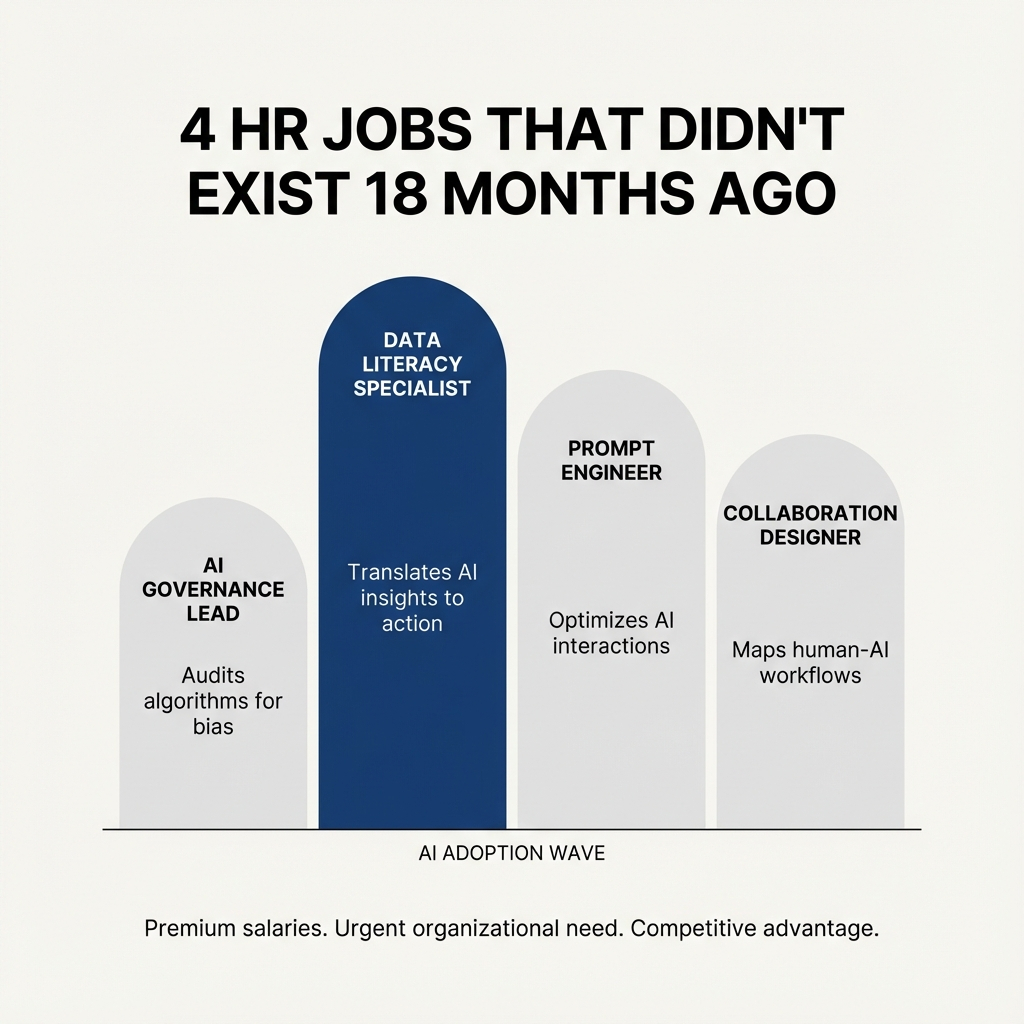
The New HR Jobs AI Just Created (And Why Your Team Needs Them Yesterday)
I've been watching something fascinating unfold across the recruitment and HR landscape.
AI isn't just changing how we work. It's creating entirely new job categories that didn't exist 18 months ago.
The data tells a clear story. Organizations are deploying AI technologies at a pace that's outrunning their ability to manage them properly. And that gap is spawning a whole new class of HR roles focused on one thing: making sure AI enhances human work instead of undermining it.
The AI Adoption Wave Is Already Here
Survey data shows that a significant percentage of organizations have already integrated AI technologies into their HR operations. We're not talking about pilot programs or experimental initiatives.
This is production-level deployment.
Companies are using AI for resume screening, candidate matching, interview scheduling, performance analysis, and predictive attrition modeling. The technology works. It delivers efficiency gains that traditional methods simply can't match.
But here's what most organizations missed: AI implementation without proper governance creates more problems than it solves.
You can't just plug in an AI tool and expect consistent, unbiased, legally compliant outcomes. Someone needs to manage the relationship between human judgment and machine processing. Someone needs to ensure the AI serves your culture, not the other way around.
That's where the new jobs come in.
The Roles AI Created (That You Probably Need to Fill)
AI Governance and Risk Leads
This role emerged because companies realized their AI tools were making decisions that affected real people's careers, and nobody was systematically checking for fairness, transparency, or bias.
An AI Governance Lead establishes the frameworks that ensure your AI systems operate within ethical and legal boundaries. They audit algorithms for bias. They create transparency protocols. They build accountability structures.
What they do daily:
Review AI-generated decisions for patterns of bias or unfairness
Establish testing protocols for new AI implementations
Create documentation trails for regulatory compliance
Train HR staff on responsible AI usage
Investigate complaints about AI-driven processes
You need this role if you're using AI for hiring, promotion decisions, performance evaluation, or compensation analysis. The legal exposure alone justifies the investment.
Data Literacy Specialists
AI runs on data. But most HR professionals weren't trained to work with data at the volume and complexity that AI systems require.
Data Literacy Specialists bridge that gap. They translate between technical data science concepts and practical HR applications. They help your team understand what the data actually means and how to use it for better decisions.
Their core responsibilities:
Teaching HR staff how to interpret AI-generated insights
Building dashboards that make complex data accessible
Identifying data quality issues that compromise AI accuracy
Creating data collection protocols that feed AI systems properly
Translating technical AI outputs into actionable HR strategies
This role matters because AI is only as good as the data you feed it and your team's ability to interpret what comes out.
Prompt Engineering and AI Training Specialists
Here's something most people don't realize: the way you interact with AI tools dramatically affects the quality of results you get.
Prompt Engineering Specialists know how to communicate with AI systems to extract maximum value. They craft the questions, structure the inputs, and design the workflows that make AI tools actually useful for HR teams.
What this looks like in practice:
Designing prompt templates for common HR tasks
Training AI models on company-specific language and culture
Optimizing AI interactions for consistency and accuracy
Creating libraries of proven prompts for different scenarios
Testing and refining AI responses for HR applications
The difference between amateur AI usage and expert-level implementation often comes down to prompt quality. This role ensures your team uses AI tools at their full potential.
Human-AI Collaboration Designers
This role focuses on the integration point between human decision-making and AI assistance. They design workflows that leverage both human intuition and machine processing power.
I call this the Hybrid AI Workforce approach. It's about creating systems where humans work at the top of their skill set while AI handles the repetitive, data-intensive tasks.
Key responsibilities include:
Mapping HR processes to identify optimal human-AI division of labor
Designing handoff protocols between AI and human decision points
Creating feedback loops that improve both human and AI performance
Building escalation procedures for edge cases AI can't handle
Measuring and optimizing the effectiveness of human-AI collaboration
This role prevents the common mistake of either over-relying on AI or underutilizing it because nobody designed the integration properly.
The Salary Reality
These roles command premium compensation because the talent pool is small and the organizational need is urgent.
Companies are willing to pay significantly more for professionals who combine HR expertise with AI literacy. The data shows clear salary premiums for AI-related skills in HR positions.
But here's what matters more than the salary numbers: these roles directly impact your ability to compete for talent.
Organizations that implement AI without proper governance, data literacy, and human-AI integration design will struggle with inconsistent results, legal exposure, and employee distrust of their HR systems.
The companies that invest in these roles gain faster, more accurate hiring processes, better candidate experiences, and measurably improved retention outcomes.
What This Means for Your HR Strategy
You have three options right now.
Option one: Continue using AI tools without specialized oversight. You'll get some efficiency gains, but you'll also accumulate technical debt, potential legal liability, and inconsistent outcomes that undermine trust in your HR systems.
Option two: Hire full-time specialists for each of these roles. This works if you're a large organization with the budget and volume to justify dedicated positions. Most small and mid-sized companies can't afford this approach.
Option three: Build AI capabilities into your existing HR team through fractional expertise, strategic consulting, and targeted training. This is where the Hybrid AI Workforce model delivers maximum value for organizations that need enterprise-level AI capabilities without enterprise-level headcount.
The Skills Your Team Needs to Develop
Whether you hire specialists or upskill your current team, these competencies become non-negotiable:
Data literacy: Your HR team needs to understand basic analytics, interpret statistical outputs, and recognize when data quality issues compromise AI accuracy.
AI governance awareness: Everyone touching AI tools should understand bias risks, transparency requirements, and the ethical implications of automated decision-making.
Prompt engineering basics: Your team should know how to structure effective AI interactions, not just accept whatever the first output delivers.
Human-AI workflow design: HR professionals need to think systematically about where AI adds value and where human judgment remains essential.
The gap between organizations that develop these capabilities and those that don't will widen rapidly. AI tools are becoming more powerful and more accessible. The differentiator is how effectively you deploy them.
The Implementation Path Forward
Start with an honest assessment of your current AI usage. Map out every point where AI touches candidate or employee data. Identify the governance gaps, the data quality issues, and the workflow inefficiencies.
Then prioritize based on risk and opportunity. AI governance comes first if you're making high-stakes decisions (hiring, promotions, terminations). Data literacy becomes urgent if your team struggles to interpret AI outputs or your data quality is inconsistent.
You don't need to hire all these roles immediately. But you do need a plan for building these capabilities into your organization.
The companies winning the talent war right now aren't the ones with the biggest budgets. They're the ones using AI strategically to move faster, decide better, and deliver superior candidate experiences.
What I'm Seeing in the Market
I work with recruiting and staffing companies implementing AI-driven systems every day. The pattern is consistent.
Organizations that treat AI as just another tool get marginal improvements. Organizations that build proper governance, develop data literacy, and design effective human-AI workflows see transformational results.
The difference shows up in measurable outcomes: faster time-to-hire, higher offer acceptance rates, better quality-of-hire metrics, and improved retention numbers.
But it also shows up in less tangible ways. Candidates report better experiences. Hiring managers trust the process more. Recruiters spend time on high-value activities instead of administrative tasks.
That's what proper AI implementation delivers when you have the right capabilities in place.
The Bottom Line
AI created these new HR roles because organizations needed them. The technology moved faster than most companies' ability to manage it properly.
You can view these new job categories as additional overhead, or you can recognize them as strategic investments that determine whether your AI initiatives deliver real value or just create new problems.
The market has already decided. Organizations are hiring for these roles. Salaries reflect the premium on AI expertise. The competitive advantage goes to companies that build these capabilities faster than their competitors.
The question isn't whether you need these skills in your organization. The question is how you'll acquire them and how quickly you can deploy them.
Because while you're deciding, your competitors are already implementing.
Ready to build AI capabilities that actually drive results? Reshaping Recruitment helps small and mid-sized recruiting and staffing companies implement Hybrid AI Workforce systems that deliver enterprise-level performance without enterprise-level costs. We bring the specialized expertise you need—governance, data strategy, human-AI workflow design—without the overhead of full-time hires. Let's talk about what AI implementation done right looks like for your organization.