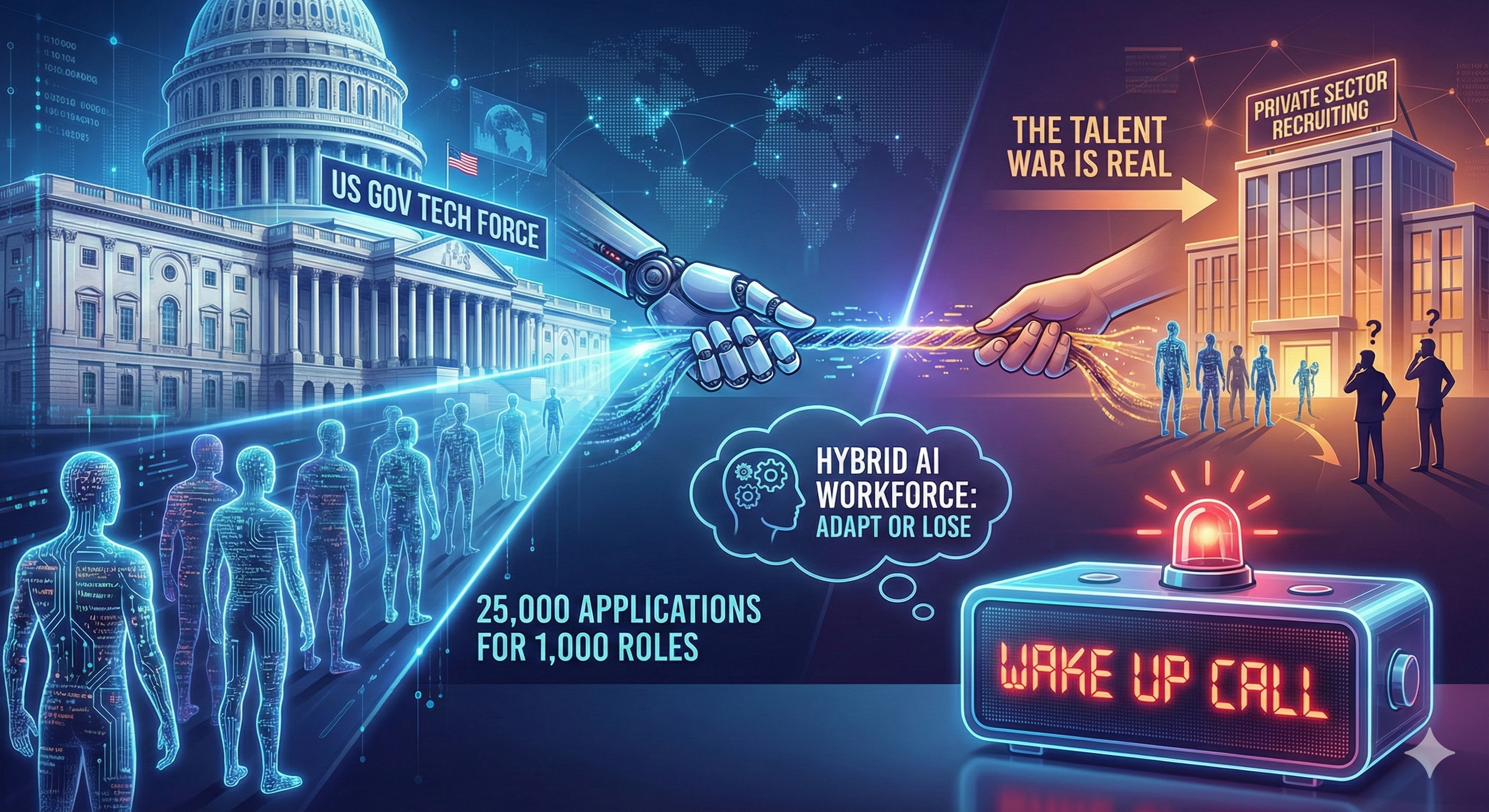
The Government's Tech Talent Grab Should Wake You Up
The Trump administration just opened applications for its "Tech Force" initiative. They're looking for 1,000 software and data engineers to work on federal AI projects.
25,000 people applied.
I'm not here to debate politics or government efficiency. What matters is what this signal tells us about the AI talent market and what it means for your recruiting operation.
The Talent War Just Got Real
When the federal government starts competing for the same AI engineers, data scientists, and software developers you need, the dynamics change fast.
These aren't just any tech roles. The government is recruiting for AI-specific positions. The same people who can build your automated screening systems, develop your predictive hiring models, and architect your data infrastructure.
You're now competing with Uncle Sam's paycheck, benefits package, and the appeal of "working on national AI strategy."
The private sector has always had an advantage in tech recruiting. Better pay, faster innovation, less bureaucracy. But 25,000 applications for 1,000 positions tells you something important: people want to work on AI projects, and they'll follow the opportunity wherever it leads.
What This Means for Small and Mid-Sized Recruiters
If you're still recruiting the old way, you're about to feel the squeeze from both ends.
Large corporations have been outbidding you on talent for years. Now add government agencies to the mix. They have deeper pockets, longer runways, and a mission-driven appeal that resonates with certain candidates.
You can't win a bidding war. You never could.
But here's what you can do: you can become more efficient at identifying, engaging, and converting the talent you can reach.
This is where AI stops being a nice-to-have and becomes your competitive weapon.
The Hybrid AI Workforce Advantage
I've spent the last five years building AI systems for recruiting and staffing companies. The pattern I see over and over is this: companies that integrate AI strategically don't just survive talent shortages. They thrive during them.
The Hybrid AI Workforce approach combines your recruiters' human insight with AI's processing power. You're not replacing your team. You're amplifying what they can do.
Here's what that looks like in practice:
AI handles the volume. It screens resumes, analyzes job descriptions, scores candidates against your criteria, and identifies patterns in your hiring data that predict success.
Your recruiters handle the nuance. They build relationships, assess cultural fit, negotiate offers, and make the final hiring decisions.
When the government pulls 1,000 tech professionals out of the private sector talent pool, you don't feel it as much because your AI systems are already working through 10x more candidates than your competitors can manually process.
Data Is Your Moat
The companies that will dominate recruiting in the next five years won't be the ones with the biggest teams or the fattest budgets.
They'll be the ones with the best data.
Every application, every email, every candidate interaction, every hire, every resignation creates a data point. Most recruiting firms throw this data away or let it sit unused in their ATS.
Smart firms are building proprietary datasets that train their AI models to predict:
Which candidates will accept offers
Which hires will stay past 90 days
Which sourcing channels produce the best talent
Which messaging resonates with specific candidate segments
This isn't theoretical. I've seen transportation and logistics staffing firms reduce their cost-per-hire by 40% using data-driven recruitment strategies while their competitors are still posting jobs and hoping.
When talent gets scarce, data becomes the difference between guessing and knowing.
The Real Threat Isn't the Government
The Tech Force initiative is a symptom, not the disease.
The real threat is that AI talent demand is exploding across every sector, and traditional recruiting methods can't keep up.
You're competing with:
Tech giants offering $300K+ packages
Startups offering equity and mission-driven work
Government agencies offering stability and benefits
Remote-first companies offering geographic flexibility
And you're doing it with the same tools and processes you used five years ago.
That's the problem.
The Window Is Closing
I talk to recruiting and staffing firm owners every week. The ones who are winning right now share three characteristics:
They've automated their repetitive tasks. Candidate screening, interview scheduling, follow-up sequences. If it's repeatable, AI handles it.
They've built data collection into every process. They're not just filling roles. They're building datasets that make every future hire easier.
They've trained their teams to work with AI, not against it. Their recruiters spend time on high-value activities because AI handles everything else.
The firms that haven't made these changes yet? They're feeling the pressure. Longer time-to-fill. Higher cost-per-hire. Lower candidate quality. Increased recruiter burnout.
The government's Tech Force initiative is just another accelerant on a fire that's already burning.
What You Should Do Next
You have two options.
Option one: Keep recruiting the way you always have. Compete on price and hope you can outwork the talent shortage.
Option two: Build a Hybrid AI Workforce that lets you identify better candidates faster, engage them more effectively, and convert them at higher rates than your competitors.
The small and mid-sized recruiting firms that dominate their markets over the next five years won't be the ones with the most recruiters.
They'll be the ones who figured out how to make AI work for them before everyone else did.
The government just showed you how serious the AI talent war has become.
The question is: what are you going to do about it?