The 55,000 Layoffs That Weren't About AI
I watched something strange happen in 2025.
Headlines screamed about 55,000 job cuts blamed on AI. Companies pointed at artificial intelligence like it was the villain in a corporate thriller. The narrative was simple: AI arrived, humans got fired, the future looks grim.
But here's what the data actually shows.
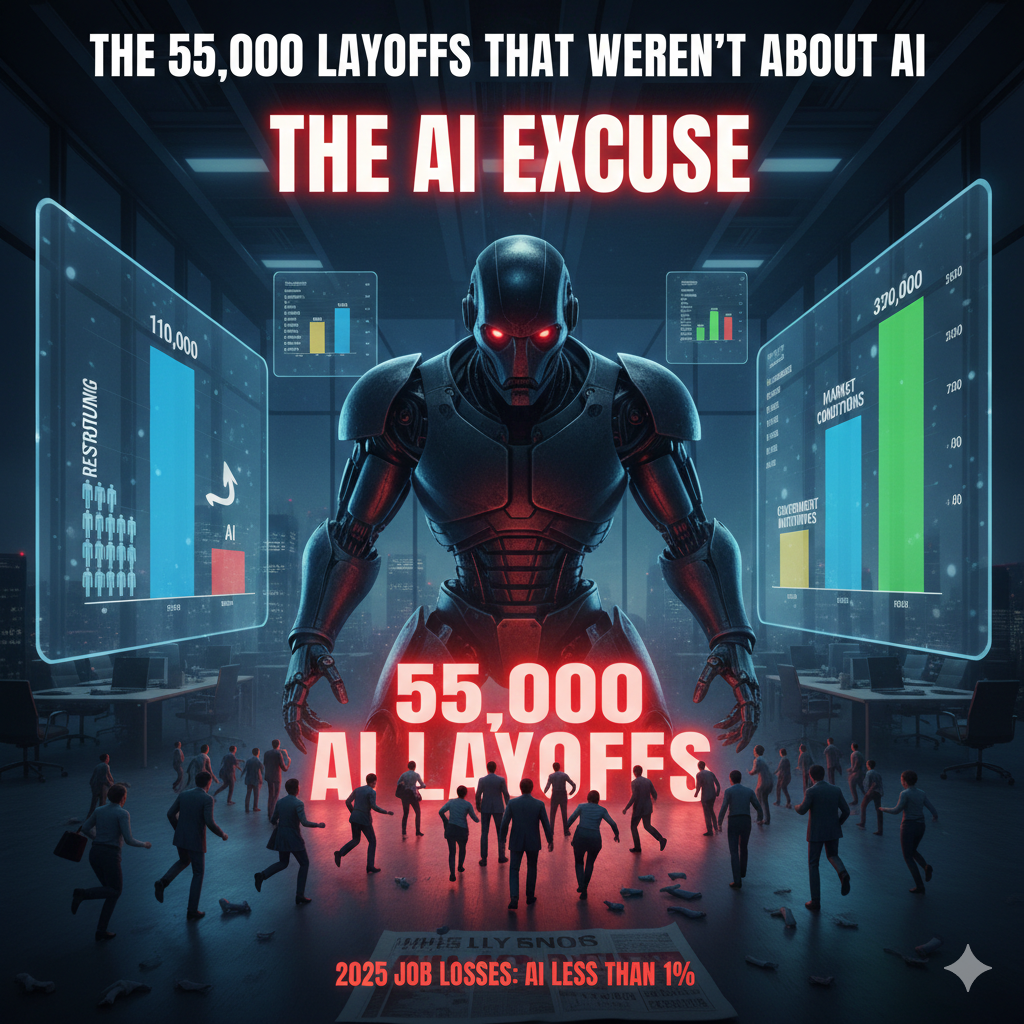
Those 55,000 AI-attributed layoffs? They represented less than 1% of all job losses in 2025. Meanwhile, more than twice as many cuts came from restructuring. Four times as many from market conditions. Nearly six times as many from government efficiency initiatives.
AI wasn't the cause. It was the excuse.
The Scapegoat Nobody Questions
Oxford Internet Institute's Fabian Stephany said it plainly: many companies "significantly overhired" during the pandemic. The layoffs we're seeing now? That's market clearance. Companies got their headcount wrong, and now they're using AI as cover instead of admitting they miscalculated.
I've spent over 20 years in recruitment and staffing, the last five specifically focused on AI strategy. I've watched this pattern before.
When print advertising collapsed, technology got blamed. When the 2008 recession hit, automation took the heat. Now it's AI's turn to play the villain while executives make decisions that have nothing to do with artificial intelligence and everything to do with balance sheets.
The truth is messier and more interesting.
What Actually Happens When You Deploy AI Right
Let me show you what the research reveals when you look past the headlines.
Workers who use AI chatbots become 14% more productive on average. That's measured by actual issues resolved per hour, not theoretical projections.
Across three major studies, productivity gains from AI average 66%. To put that in perspective, that's equivalent to 47 years of natural productivity gains in the United States compressed into a single implementation cycle.
When AI operates within its actual capabilities, worker performance improves by nearly 40% compared to those who don't use it.
These aren't small numbers. They're transformational.
But here's where it gets interesting for small and mid-sized businesses.
The Skills Equalizer Nobody Expected
The least skilled and least experienced workers saw productivity gains of up to 35% when using AI tools. Junior programmers increased coding productivity by 55%, with one third of that directly attributable to code generated by large language models.
Lower-skilled workers improved both speed and quality of output.
Meanwhile, the most experienced workers saw small gains in speed and small declines in quality. They already operated at peak human performance. AI didn't replace their expertise—it elevated everyone else closer to their level.
This is the part that changes everything for recruitment and staffing.
You can hire talented people who need development and use AI to accelerate their growth curve. You can build teams that punch above their weight class. You can compete with larger organizations without matching their salary structures.
But only if you understand what AI actually does versus what executives claim it does when they're justifying layoffs.
The One Job Category That Got Hit Hard
Programmer employment fell 27.5% between 2023 and 2025, according to U.S. Bureau of Labor data.
Nobody predicted this would be the biggest impact area. Programming is solitary, highly structured work. The tasks break down into discrete, repeatable patterns. AI excels at exactly this type of work.
Big Tech companies reduced new graduate hiring by 25% in 2024 compared to 2023.
This is real displacement. This is actual AI impact.
But here's what separates this from the broader narrative: this happened in one specific job category with specific characteristics. It didn't cascade across all knowledge work. It didn't eliminate the need for human judgment in recruitment, sales, customer service, or strategic planning.
It eliminated entry-level coding tasks that were already becoming commoditized.
The lesson? AI impacts different roles differently. Your job as a business leader is to understand which tasks in your organization are vulnerable to automation and which are enhanced by it.
The Small Business Advantage Nobody Talks About
Here's what happened while everyone panicked about job losses:
82% of small businesses now think adopting AI is essential to stay competitive. 25% have already integrated AI into daily operations. Over 50% are actively exploring implementation.
The businesses that deployed AI? 91% report it boosts their revenue.
And here's the kicker: 82% of small businesses using AI increased their workforce over the past year.
Read that again.
The companies using AI hired more people, not fewer. They automated the repetitive tasks that drained time and energy. They freed their teams to focus on high-value work that requires human judgment, creativity, and relationship building.
This is what I call the Hybrid AI Workforce model.
You don't replace humans with AI. You augment human capabilities with AI tools that handle the grunt work. Your recruiters stop spending hours screening resumes and start spending that time building relationships with top candidates. Your sales team stops manually updating CRM records and starts closing deals.
The productivity gains don't eliminate jobs. They eliminate the parts of jobs that nobody wanted to do anyway.
The Strategic Shift You Need to Make
Stanford's Erik Brynjolfsson put it clearly: "The lesson is that, more often than not, you'll benefit by augmenting workers rather than trying to replace them."
Employers who interpret AI research as an excuse to lay off higher-skilled workers miss the point entirely.
I've built my entire practice around this principle. When I work with recruiting and staffing companies, transportation and logistics firms, and other SMEs, I don't come in talking about headcount reduction. I come in talking about capability expansion.
Workers using generative AI save 5.4% of work hours. That translates to a 1.1% increase in aggregate productivity. But here's the important part: workers are 33% more productive in each hour they actually use AI.
The question isn't whether to adopt AI. The question is how to deploy it so your team becomes more capable, not more replaceable.
What This Means for Your Recruitment Strategy
I wrote "Reshaping Recruitment" because I saw small businesses struggling with outdated methods while watching larger competitors claim AI was going to solve everything.
The truth sits between those extremes.
AI won't replace your recruitment team. But your recruitment team augmented with AI will outperform teams twice their size that rely on manual processes.
The Hire Up Funnels I developed automate the repetitive tasks that slow down candidate engagement. The psychology-based messaging frameworks help you connect with candidates on a personal level at scale. The data-driven strategies let you make informed decisions about which candidates will succeed and stay long-term.
This isn't theory. This is what I've built and deployed in the transportation and logistics industry, one of the hardest recruiting environments in the country.
When you track data throughout the employee lifecycle—from initial application to onboarding and beyond—you build predictive models that tell you which recruiting channels work, which messaging resonates, and which candidates are worth your time.
You move from intuition-based hiring to data-informed hiring while keeping human judgment at the center of every decision.
The Real Competitive Advantage
Small businesses are seeking "increasingly sophisticated solutions that can transform their decision-making processes and competitive positioning." AI is "becoming essential for maintaining competitiveness in today's market."
But here's what matters: when it's accessible, understandable, and built for real-life use, AI can be a great equalizer for small businesses.
AI-powered automation can increase productivity by up to 40%. That gives you a significant competitive edge against larger competitors with bigger budgets but slower decision-making processes.
You can move faster. You can test strategies cheaper. You can pivot quicker when something doesn't work.
The companies dominating their markets right now aren't the ones with the most resources. They're the ones who figured out how to leverage AI to amplify their existing strengths.
The Choice You're Actually Making
Those 55,000 layoffs blamed on AI? They teach us something important about how executives use technology narratives to justify business decisions.
But the hundreds of thousands of small businesses deploying AI and growing their teams? They teach us something more important about how technology actually works when you use it right.
You can follow the headlines and panic about AI taking jobs.
Or you can look at the data and realize AI gives you the tools to compete with companies that used to be untouchable.
I've spent five years building AI strategies for recruitment because I saw this opportunity before it became obvious. The Hybrid AI Workforce model I developed combines human intelligence, insight, and intuition with AI capabilities that handle scale and repetitive tasks.
Your hiring decisions still get made by humans. AI just makes those humans better informed, more efficient, and capable of managing more candidates without sacrificing quality.
The businesses winning right now understand this. They're not replacing their teams. They're upgrading their capabilities.
What You Should Do Next
If you run a recruiting and staffing company, a transportation and logistics firm, or any SME competing against larger players, you have a decision to make.
You can keep doing things the way you've always done them and hope your experience carries you through.
Or you can adopt the systems that let you outperform competitors with bigger teams and deeper pockets.
The Hybrid AI Workforce framework I teach in "Reshaping Recruitment" shows you exactly how to implement AI without replacing your team. The three-part hiring system—Hire Up Funnels, psychology-based messaging, and data-driven strategies—gives you the blueprint for attracting, engaging, and closing top candidates faster than your competition.
This isn't about following trends. This is about setting them.
The companies that figure this out now will dominate their markets for the next decade. The ones that wait will spend that decade trying to catch up.
I don't just write about this stuff. I build it, deploy it, and prove it works in real businesses facing real challenges.
The question is whether you're ready to move from theory to execution.
Because the AI revolution isn't coming. It's here. And the businesses that understand how to use it as an amplifier rather than a replacement are already pulling ahead.
The choice is yours.