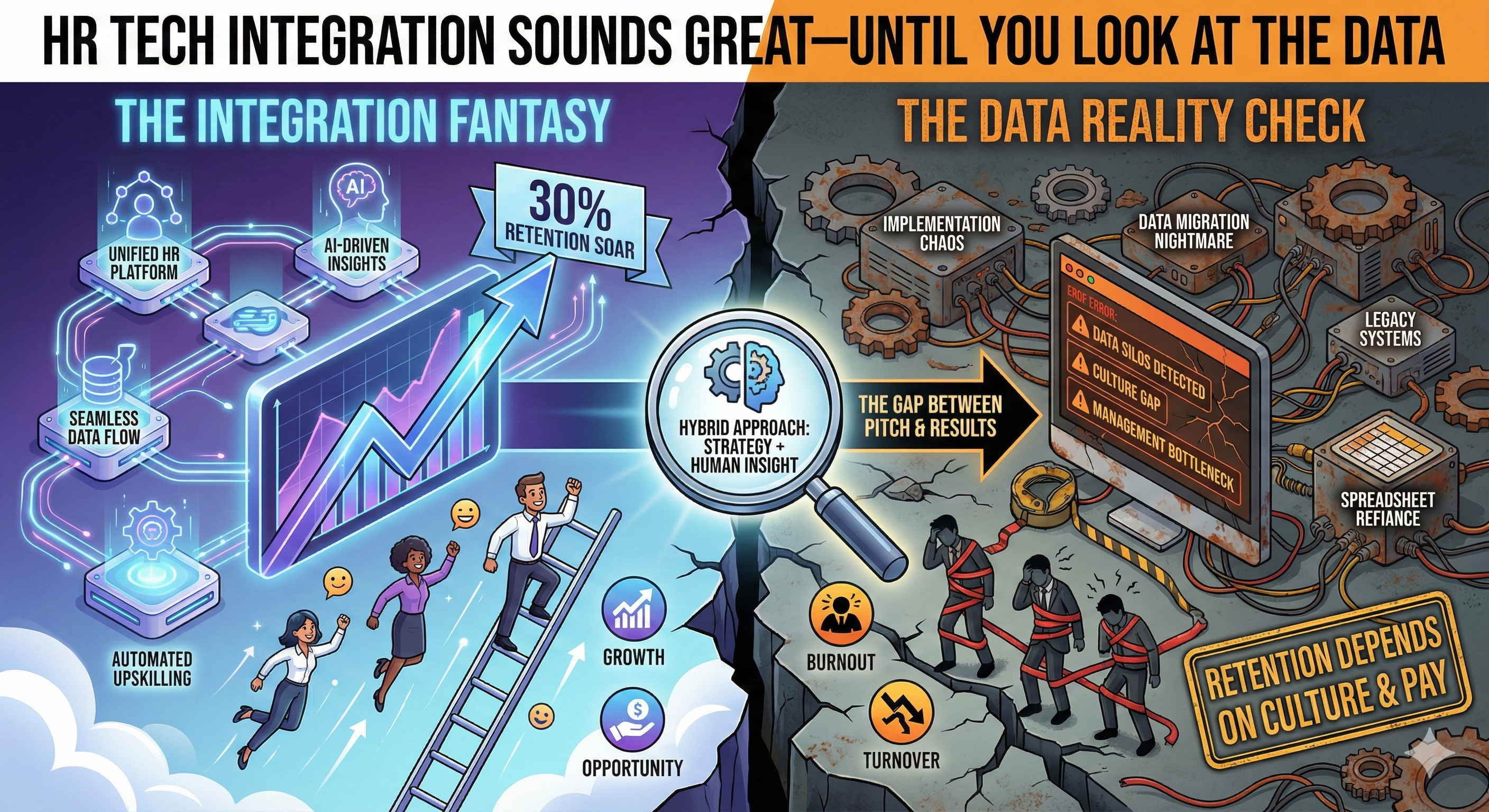
HR Tech Integration Sounds Great—Until You Look at the Data
I keep hearing the same pitch: integrate your HR systems, connect everything into one digital ecosystem, and watch retention soar by 30%.
The promise is seductive. One unified platform where learning data flows into performance reviews, where development opportunities appear automatically, where everything just works together.
But I've been in this game long enough to ask the uncomfortable questions.
The Integration Fantasy vs. Reality
HR technology vendors love talking about unified digital ecosystems. They show you sleek demos where data moves seamlessly between systems, where AI recommends the perfect training at the perfect moment, where employees naturally develop new skills and stick around longer.
Here's what they don't show you in those demos:
The six months of implementation chaos. The data migration nightmares. The employees who ignore the new system entirely. The managers who keep using their old spreadsheets because the new platform is too complicated.
I'm not saying integration doesn't work. I'm saying the gap between the sales pitch and actual results is wider than most companies expect.
The 30% Retention Claim Needs Context
That 30% retention increase from AI-driven HR solutions gets thrown around like it's guaranteed.
But retention depends on factors no software can fix:
Compensation. If you're paying below market rate, no amount of AI-powered development planning will keep your best people.
Management quality. Bad managers drive people out faster than any HR system can pull them back in.
Company culture. You can't automate your way out of a toxic workplace.
Career advancement opportunities. If there's nowhere to grow, employees leave. A learning management system won't create positions that don't exist.
The data showing retention improvements typically comes from companies that already had strong fundamentals in place. They weren't broken—they were optimizing.
If your retention problems stem from deeper issues, technology integration becomes an expensive distraction.
Internal Upskilling: The Real Opportunity
Here's where I actually see value: internal mobility and upskilling programs.
When you build a system that genuinely helps employees develop new capabilities and move into different roles within your organization, you create something powerful.
This works because it addresses a real problem. Employees want growth. Companies need to fill positions. External hiring is expensive and time-consuming.
But—and this is critical—the technology is just the infrastructure.
You still need:
• Managers who actively support employee development instead of hoarding talent
• Clear career pathways that actually exist in your organization
• Training programs that deliver real skills, not just completion certificates
• A culture that values internal promotion over external hiring
The HR tech platform can connect the dots, but you have to create the dots first.
What Actually Drives Results
I've watched companies spend millions on integrated HR systems and see minimal impact. I've also watched companies implement focused, targeted solutions that transform specific processes.
The difference comes down to strategic clarity.
The companies that succeed with HR tech integration start with a specific problem. They want to reduce time-to-hire for critical roles. They want to identify high-potential employees earlier. They want to reduce training costs while improving outcomes.
They implement technology to solve that specific problem. They measure results against clear benchmarks. They adjust based on data, not vendor promises.
The companies that struggle start with the technology and then look for problems it might solve. They buy comprehensive platforms because "everyone's integrating their HR systems." They measure success by implementation completion, not business outcomes.
The Hybrid Approach That Works
Here's what I've built with the Hybrid AI Workforce model: systems where AI handles the data analysis, pattern recognition, and administrative work, while humans make the strategic decisions.
In HR technology, this means:
AI analyzes employee data to identify patterns—who's at risk of leaving, who's ready for advancement, what skills gaps exist across teams.
Humans use those insights to have actual conversations. To understand context the data can't capture. To make decisions that account for individual circumstances.
The technology doesn't replace judgment. It informs judgment.
This approach delivers results because it acknowledges reality: people are complex, and workplace dynamics don't fit neatly into algorithms.
The Questions You Should Ask
Before you invest in HR tech integration, get specific answers:
What exact business problem are you solving? Not "improving retention" but "reducing turnover in our sales team by addressing the specific factors driving departures."
How will you measure success? Define metrics before implementation, not after.
What processes need to change? Technology doesn't fix broken processes—it accelerates them. Fix the process first.
Who will actually use this system? If managers won't engage with it, the integration is worthless.
What happens to the data? Integration means more data flowing through more systems. Who controls it? Who can access it? What are the security implications?
The Real Value Proposition
Integrated HR systems can deliver value. But the value comes from strategic implementation, not from integration itself.
You need clear objectives. You need process discipline. You need leadership commitment. You need realistic expectations about what technology can and can't do.
The vendors selling comprehensive HR platforms won't tell you this because it's not their job. Their job is to sell software.
Your job is to build a workforce strategy that actually works for your business. Sometimes that includes integrated HR technology. Sometimes it doesn't.
The companies that win aren't the ones with the most sophisticated systems. They're the ones that match technology capabilities to real business needs and execute with discipline.
That's the difference between buying software and building competitive advantage.
And that difference shows up in your retention numbers, your hiring costs, and your ability to develop talent faster than your competitors.
Just don't expect the technology to do the work for you.