90% of Companies Are Wasting ChatGPT (Here's What the Data Actually Shows)
The National Bureau of Economic Research just dropped numbers that should make every business leader pause.
They analyzed 1.1 million ChatGPT conversations between May 2024 and June 2025. The findings? 10% of the global population now uses ChatGPT. That's roughly 800 million people.
But here's what caught my attention: the breakdown of how people actually use it.
The Usage Reality Check
28% of ChatGPT usage goes to writing tasks. Editing. Personal writing. Translation. Summary generation.
Another 28% goes to hands-on assistance. Tutoring. Advice. Health questions. Creative ideation.
Visual and creative output? Just 5%.
I've spent over two decades in recruitment and the last five years building AI systems for staffing companies. These numbers tell me something most businesses are missing.
People are using ChatGPT like a better Google. A smarter spell-checker. A faster translator.
They're not building systems. They're not capturing data. They're not creating competitive advantages.
The Real Problem Hidden in the Data
When I look at these usage patterns, I see tactical deployment without strategic architecture.
Writing tasks and assistance queries are valuable. I'm not dismissing them. But they represent surface-level AI adoption in a world where AI can fundamentally reshape how you operate.
Here's what the data doesn't show: How many of those conversations are integrated into business systems? How many are feeding your CRM? How many are building your knowledge base? How many are training your recruitment funnels?
My guess? Almost none.
Most companies are using ChatGPT the way someone in 1995 used email to send memos instead of building an entire digital communication infrastructure.
What 90% of Companies Are Missing
The gap between using AI and deploying AI strategically is massive.
I've worked with small and mid-sized recruiting firms that thought they were "doing AI" because their recruiters used ChatGPT to write job descriptions.
That's like thinking you're doing digital marketing because you have a Facebook page.
The companies winning with AI right now aren't just using ChatGPT for tasks. They're building Hybrid AI Workforces.
They're combining human intelligence with AI capabilities in ways that create systems, not just outputs.
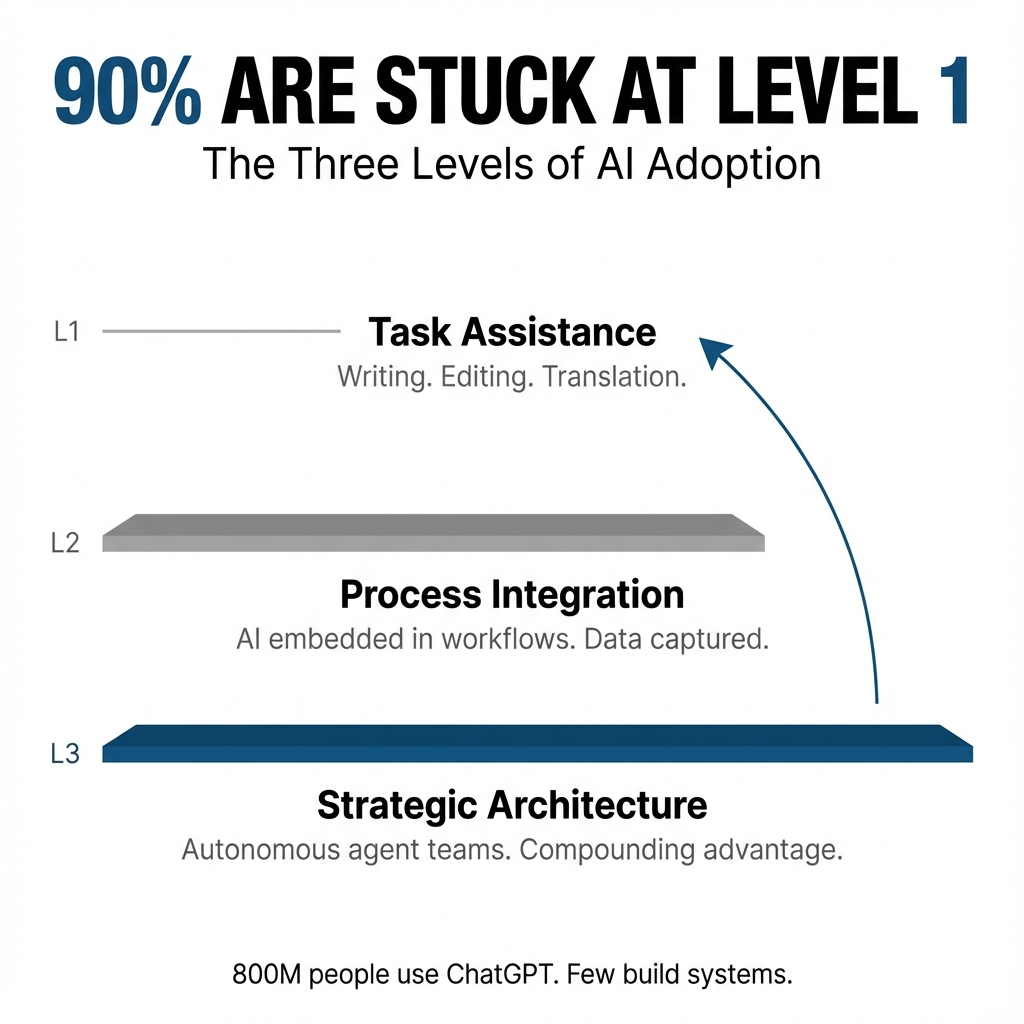
The Three Levels of AI Adoption
Level 1: Task Assistance
You use ChatGPT to write emails, summarize documents, or generate ideas. This is where 90% of companies are stuck. It's helpful, but it's not transformative.
Level 2: Process Integration
You embed AI into your workflows. Your CRM uses AI to score candidates. Your recruitment funnel uses AI to personalize messaging. Your data gets captured, organized, and analyzed.
Level 3: Strategic Architecture
You build AI agent teams that operate autonomously within defined parameters. Your Hybrid AI Workforce handles repetitive tasks, surfaces insights, and frees your human team to work at the top of their capability.
The NBER data shows us that most usage sits firmly in Level 1.
The competitive advantage lives in Levels 2 and 3.
What This Means for Your Business
If you're in recruitment, staffing, sales, or any business where talent and relationships drive revenue, you need to understand something critical:
Your competitors are using the same ChatGPT you are.
The difference between winning and losing isn't access to the technology. It's how you architect it into your operations.
I've seen small staffing firms outperform companies ten times their size because they built systems instead of just using tools.
They didn't just use AI to write better job postings. They used AI to:
Analyze candidate behavior patterns across their entire funnel
Predict which candidates would accept offers and stay long-term
Automate follow-up sequences that re-engaged dropped candidates
Build private talent pools that became sustainable competitive moats
That's not ChatGPT as a writing assistant. That's AI as a strategic force.
The Data Architecture Gap
Here's what most businesses don't realize: AI is only as powerful as the data you feed it.
When you use ChatGPT for one-off tasks, you're not building a data foundation. You're not creating a feedback loop. You're not training systems that get smarter over time.
The companies that will dominate the next five years are the ones building data architectures right now.
They're capturing every candidate interaction. Every application drop-off point. Every successful hire. Every retention pattern.
They're feeding that data into AI systems that can predict, optimize, and scale.
The 28% of people using ChatGPT for writing tasks? They're getting value. But they're not building equity.
How to Move Beyond the 90%
If you want to use AI strategically instead of tactically, you need to shift your thinking.
Stop asking: "What can AI do for me right now?"
Start asking: "What systems can I build with AI that compound over time?"
In recruitment, that means building Hire Up Funnels that automate candidate engagement while capturing behavioral data. It means using psychology-based messaging that resonates on a personal level while feeding machine learning models. It means creating data-driven recruitment strategies that get more accurate with every hire.
This isn't about replacing your team. It's about augmenting them.
Your recruiters shouldn't be spending their time on repetitive administrative tasks. They should be building relationships, making strategic decisions, and leveraging insights that AI surfaces.
The Window Is Closing
Right now, there's a window of opportunity.
Most companies are still in the "ChatGPT for task assistance" phase. They're using AI like a better intern instead of a strategic partner.
The businesses that architect AI into their operations now will build advantages that are hard to replicate later.
The NBER data shows us that AI adoption is widespread. But widespread adoption of tactical tools doesn't create competitive advantage. Strategic architecture does.
I've spent the last five years helping small and mid-sized businesses build Hybrid AI Workforces that let them compete with companies that have ten times their resources.
The difference isn't budget. It's approach.
You don't need a massive tech team. You don't need a seven-figure investment. You need a strategic framework that combines human intelligence with AI capabilities in ways that create compounding value.
What You Can Do Today
Start by auditing how you're currently using AI.
Are you using it for one-off tasks? Or are you building systems?
Are you capturing data? Or are you just generating outputs?
Are you training models that get smarter? Or are you starting from scratch every time?
If you're in the 90% that's using AI tactically, you're not behind. But you need to move intentionally toward strategic architecture.
The companies that win over the next five years won't be the ones with the most AI tools. They'll be the ones with the best AI systems.
And those systems are being built right now.
The question is whether you're building them or watching others do it.